Why OE-Based Aftermarket Supply Chains Matter in the Era of Global Supply Chains

Supply Chain Competitiveness Is Now Defined by Risk Management
In recent years, the automotive industry has faced a wide range of external challenges, including expanding tariffs, protectionist trade policies, geopolitical conflicts, and logistics uncertainties. These developments have forced companies to rethink the structure of global supply chains, and the automotive parts industry has been directly affected by these changes.
In the past, reducing production costs was considered the primary source of competitive advantage. Today, however, the landscape has changed. As production sites shift and supply chains become increasingly regionalized, companies are focusing less on cost competition and more on maintaining stable and reliable supply.
These changes are equally evident in the automotive aftermarket. What customers increasingly demand is predictable quality and dependable product availability.
When Supply Chains Are Disrupted, Customer Operations Are Disrupted Too
Changes in the global business environment create ripple effects throughout the automotive parts industry.
When tariff policies change, production sites may be relocated, new suppliers are introduced, and logistics networks are restructured. If products are not sufficiently validated or supply chains are not managed consistently during this transition, quality variations may occur. At the same time, changing transportation conditions and production schedules can make delivery performance less predictable.
These challenges ultimately have a direct impact on customers using automotive parts. Distributors may struggle to secure inventory when it is needed, repair shops may be unable to complete vehicle repairs according to schedule, and fleet operators may experience reduced vehicle utilization due to unexpected parts shortages.
Supply chain uncertainty extends far beyond logistics. It can directly create operational risks for customers, including:
- Difficulty securing inventory for distributors
- Delays in vehicle repair schedules
- Reduced fleet vehicle availability and utilization
- Disruptions to customer service schedules
Why Does an OE Supply Chain Place So Much Emphasis on Stability?
In this environment, the value of an OE-based supply chain becomes even more significant.
OE suppliers work alongside vehicle manufacturers throughout the vehicle development process, long before mass production begins. During this process, they accumulate extensive experience in quality standards, vehicle system integration, durability testing, performance validation, and manufacturing processes. This foundation enables them to maintain consistent quality across multiple production sites while adapting to changing supply chain environments.
The strength of an OE supply chain lies not only in the product itself, but also in the standardization of the entire process—from development and production to quality assurance and global supply.
Global Manufacturing Networks Improve Supply Continuity
Across today's automotive industry, companies are increasingly diversifying production across multiple regions rather than concentrating manufacturing in a single country.
These global manufacturing networks provide an important foundation for reducing supply chain risks. Even if tariffs, logistics disruptions, or geopolitical issues affect one region, production can continue by leveraging other manufacturing sites.
Furthermore, when production transfers become necessary, standardized manufacturing systems and operational processes help minimize supply disruptions. As supply chains become more complex, the importance of Multi-site Manufacturing continues to grow.
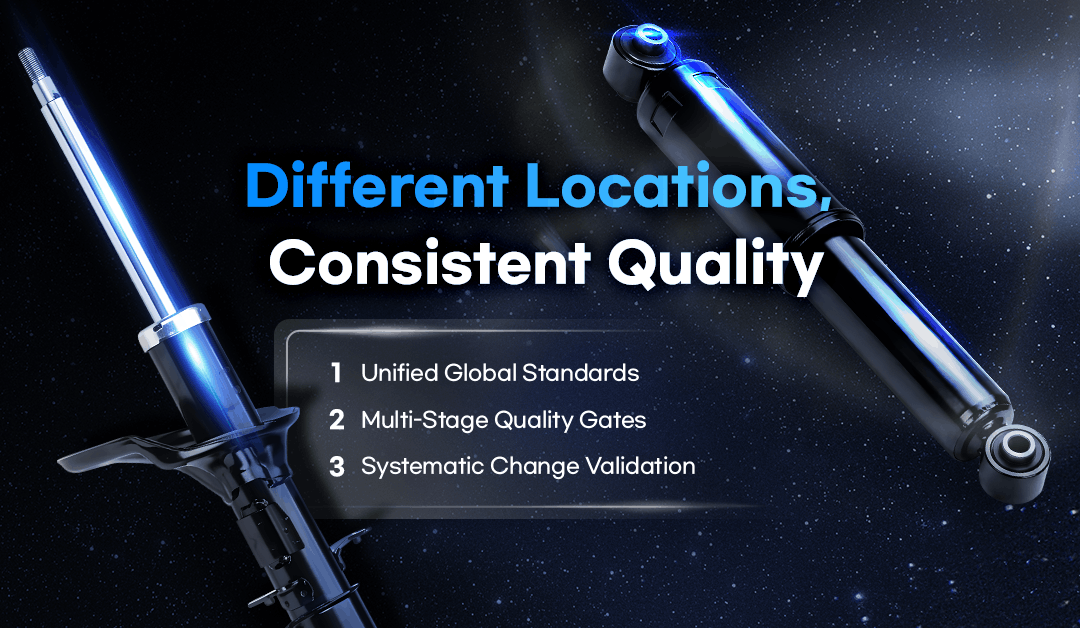
Product Quality Is Built by Systems, Not by Location
Customers expect the same level of quality regardless of where a component is manufactured.
Achieving this requires every production facility to operate under the same quality management system. Manufacturing processes must follow Global Standards, quality must be verified through structured Quality Gates, and any production changes must undergo systematic validation before implementation.
The automotive industry is particularly rigorous in managing manufacturing processes and product approval procedures. These standardized quality systems provide the foundation for maintaining consistent product quality, even when production locations change.
Customers Are Buying More Than Just Parts
Price remains an important consideration in the automotive aftermarket. However, in day-to-day operations, the ability to receive products when they are needed is often just as important.
When repair schedules are delayed, customer service is affected. Inventory shortages can cause distributors to miss sales opportunities, while fleet operators may need to revise entire vehicle operation plans.
When supply becomes unreliable, even a high-quality product cannot fully deliver its value.
For this reason, many companies today view supply reliability as a more important competitive factor than brand recognition alone. Ultimately, customers are not simply purchasing automotive parts—they are investing in predictable operations and dependable supply.
OE-Based Supply Chains Reduce Customer Risk
In today's rapidly evolving global supply chain environment, manufacturing excellent products alone is no longer enough.
The ability to maintain consistent quality and deliver reliable supply despite changing geopolitical conditions and supply chain disruptions has become an increasingly important competitive advantage.
HL Mando Aftermarket addresses these challenges by leveraging the quality standards and validation expertise developed through its OE experience. Through its global manufacturing network and standardized quality management systems, the company strives to deliver the consistent quality and supply reliability that customers expect, even as supply chain conditions continue to evolve.
Looking ahead, competitiveness in the automotive aftermarket will increasingly depend on the ability to maintain consistent quality and reliable supply despite ongoing global supply chain uncertainty. In this environment, OE-based supply chains will continue to play a critical role in reducing customers' operational risks and strengthening long-term business resilience.
Learn more about HL Mando Aftermarket's OE-based quality systems and global supply capabilities.
Next in this series
Explore Our Catalog
Find original quality parts built for reliable global supply.
View Catalog
“Built on OE quality, trusted for global supply.”